
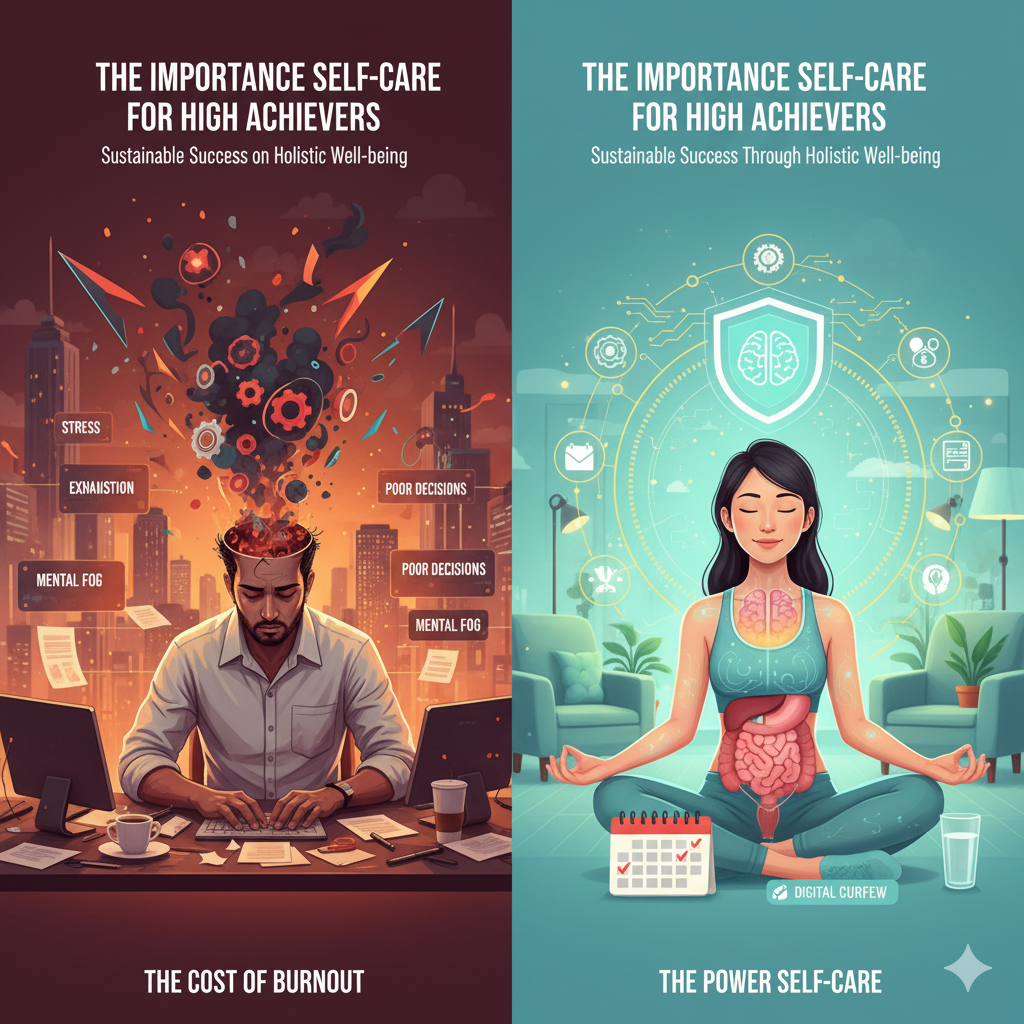
If you consider yourself a high achiever, you probably think that success necessitates never-ending movement, unrelenting work, and the persistent postponement of relaxation. “Busy” is a badge of honor that you wear as you persevere through late nights and hectic schedules. Burnout is an unspoken yet serious consequence of this fast-paced, constantly-on existence. In this atmosphere, self-care is frequently written off as a luxury or a post-big success reward. The reality is that self-care is the unavoidable cornerstone of consistent, superior performance for high achievers; it is not a luxury. Your internal engine doesn’t overheat and seize up because of the planned maintenance.
The ability of thoughtful self-care to control your most valuable resource—cognitive energy—is its primary advantage. Your brain functions at a quarter of its capacity when you are constantly under stress or are not getting enough sleep. You become more prone to emotional overreaction, poor decision-making, and mental fog. Engaging in self-care activities, such as obtaining eight hours of sleep, going for a mindful stroll, or disconnecting entirely for one evening, is not an act of passive indulgence. They are competent, proactive actions. They enable your prefrontal brain to rest, digest information, and sustain the acute concentration and sophisticated problem-solving abilities that characterize great success.
Making disciplined decisions is necessary to develop excellent self-care, frequently during times when you believe you have the least amount of time. It’s not only about responding to an emergency; it’s about arranging preventative care. To prevent blue light and mental chatter from disturbing your sleep, this might be as easy as implementing a digital curfew an hour before bed. Alternatively, it could entail scheduling five-minute deep breathing exercises or hourly trips to the water cooler as micro-breaks throughout the day. These brief, unavoidable periods of silence break the cycle of stress and promote mental healing, demonstrating that the most fruitful breaks are frequently those you plan before you’re feeling worn out.
In the end, the most calculated step a high achiever can take is to reframe self-care as an essential performance enhancer rather than a reward. When you make a commitment to holistic well-being, you begin to understand that being well-rested, emotionally balanced, and cognitively clear directly leads to your best work and stop conflating burnout with productivity. The individual who continuously and prudently manages their own irreplaceable human energy will attain true longevity in their endeavors, not the one who works the hardest.