
Everyone has had that exhilarating burst of motivation. It’s what motivates you to undertake that major project, enroll in the online course, or purchase a gym subscription. It’s a beautiful but ephemeral sensation, like a powerful wind that can blow away in an instant. The issue is that most people wait for the emotion to appear before starting work, treating motivation as the catalyst for success. However, what occurs when the emotion fades, as it always does? That early fire isn’t the real key to any major, long-term accomplishment, whether it’s developing a great business or finishing a marathon. It’s discipline’s silent, steady force. Long after the winds of motivation have died down, discipline is the steadfast ship that keeps going.
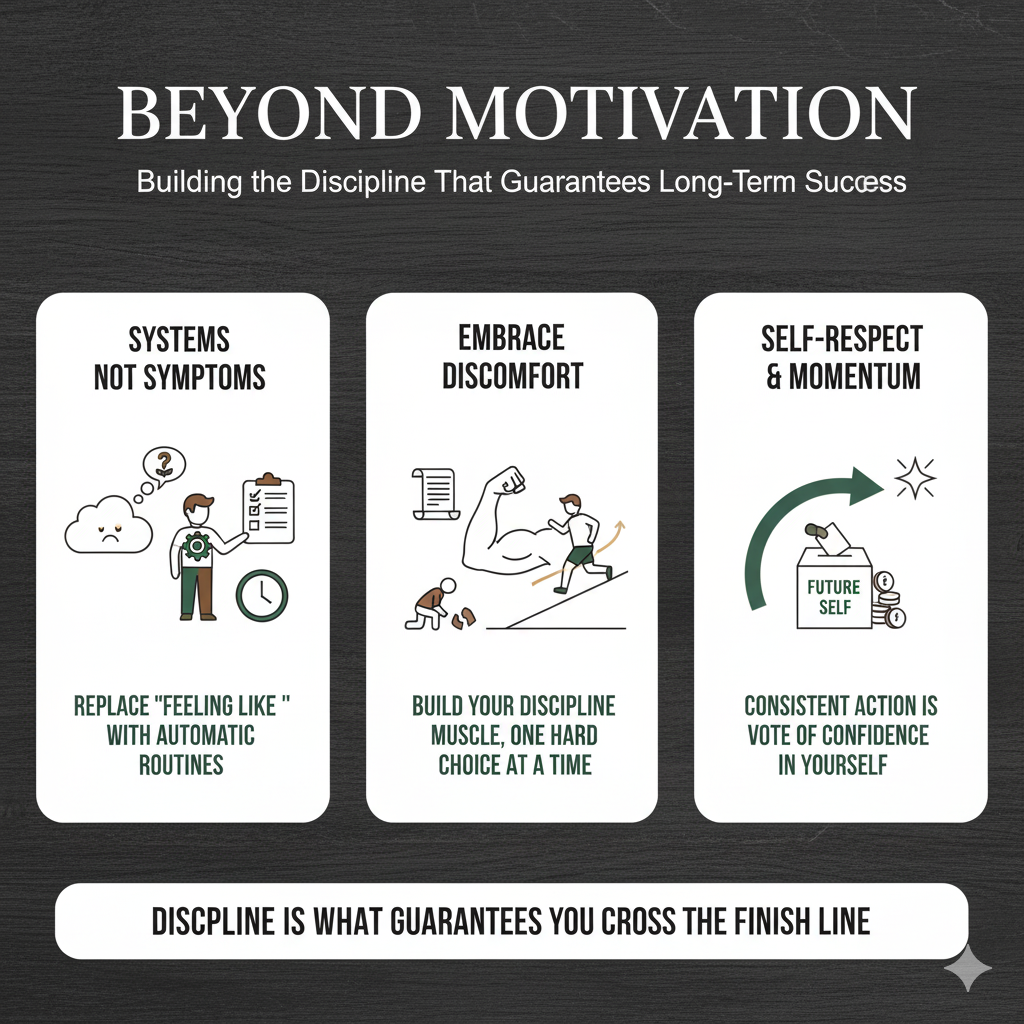
Your mood is infamously unpredictable, and depending on it is equivalent to depending on motivation. On the other hand, discipline is a dedication to activity, no matter how one feels. Consider prosperous professionals: they don’t just show up for work when they’re motivated; they do so because they have a routine and a dedication. Here, the most important mentality change is from “I need to feel like doing it” to “I need to have a system that does it for me.” This entails making the way to your desired behavior simpler. It includes setting up environmental cues (e.g., putting the book you want to read next to your coffee maker), scheduling out non-negotiable work time on your calendar, and getting your gym gear ready the night before. When the action becomes automatic, you sidestep the need for a motivational pep talk entirely.
Being a robot is not the goal of developing discipline; rather, it is about consciously increasing your threshold for discomfort. You are using your discipline muscle every time you select the long-term objective above the instant gratification (e.g., writing instead of scrolling, or sticking to your budget instead of making impulsive purchases). These little “doing it anyway” exercises are what strengthen your mind. This is not about punishing yourself; rather, it’s about recognizing the voice in your head that tells you to “just skip today” and making the better, more difficult decision in a firm but gentle manner. In fact, the discomfort decreases with time—not because the work becomes simpler, but rather because your ability to manage it increases. You discover that forward momentum is defined as performing while feeling uneasy.
In the end, discipline is more about respecting oneself internally than it is about outward limitations. It involves keeping your word to yourself as well as to other people. Every diligent step you take toward a long-term goal, like being financially independent or becoming proficient in a skill, is a vote of confidence in your future self. It’s the assurance that, even on the days you don’t want to, you will take responsibility for your own life. As a result, a strong, self-reinforcing circle is created: the more you respect yourself and your commitments via discipline, the simpler it is to stick with them. Discipline is what guarantees you cross the finish line and get the rewards of consistent, deliberate effort; motivation is what gets you started.