
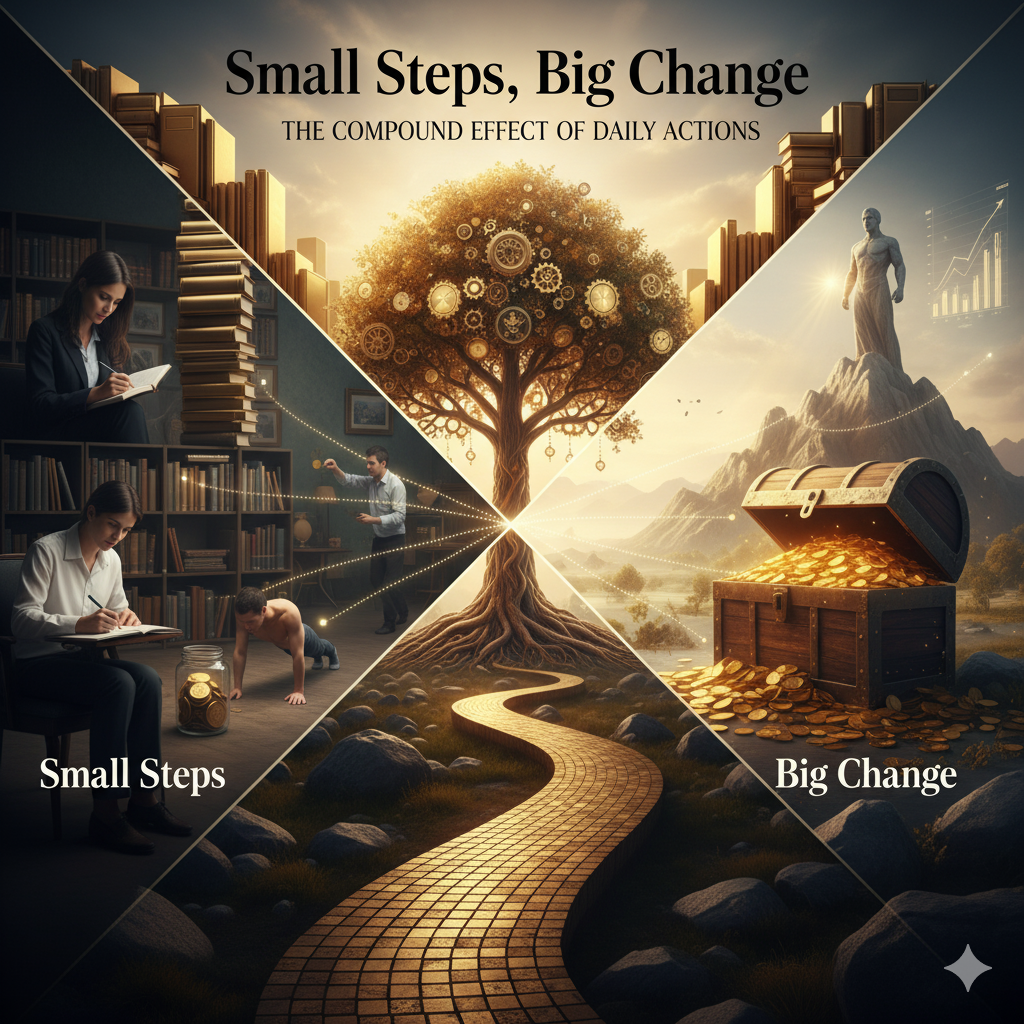
Whether it’s learning a new language, saving for a huge purchase, or drastically improving our health, everyone has lofty aspirations and ambitions that seem insurmountable. However, it can be debilitating to look at the enormous distance between where you are and where you wish to be. Small activities are frequently disregarded since they don’t appear important enough to make a difference. However, the reality is that a single heroic leap rarely results in a life-altering metamorphosis. Through the patient, potent force of the compound action, it occurs gradually.
Similar to compound interest in money, the compound effect is a subtle force that produces enormous consequences that seem to happen out of nowhere over time from little, consistent acts taken over time. The repetition and accumulation of the activity, rather than the deed itself, are what make it magical. Imagine an airplane taking off. The plane lands at a different city after that initial small change in direction, which is maintained across a 3,000-mile voyage. Your daily decision is that “small adjustment” in your life.
The Compounding Habits Anatomy
The sustainability of little steps is what gives them their force. Making a significant change takes a lot of willpower and frequently wears it out quickly. A tiny shift creates long-lasting momentum with little effort.
1. Regularity Rather than Intensity
Above all things, make a commitment to constancy when you begin something new. Setting aside an hour each day to write a book could feel overwhelming. Instead, make a daily commitment to write one paragraph. This is easy to incorporate into a busy schedule and takes little work. You’re much less inclined to skip it because it’s so simple. The individual who set an hourly goal and gave up after three weeks is still at zero, but by the end of a year, those daily paragraphs will have added up to a completed work.
2. The Phase of Invisible Results
The “invisible results” phase is the most challenging aspect of the compound effect. For the first few weeks or months, you might not see any noticeable difference. If you save $5 a day, your bank account doesn’t look instantly different. If you do 10 push-ups a day, your body won’t transform overnight. This is the moment most people quit because they mistake slow progress for no progress.
The secret is to trust the process. That small, daily deposit into your goal account is working underground, like tree roots deepening before the trunk shoots up. The results don’t follow a straight line; they follow an exponential curve, where the real visible payoff comes suddenly, long after you’ve put in the initial effort.
Sticking to Little Steps
You must plan your day for success if you want to make sure that your little acts add up to a big impact.
Eliminate Friction: Make the right decision the simplest. Always have a full water bottle on your desk if you want to increase your water intake. Put the book on your pillow so you practically have to move it before you fall asleep if you want to read more. The positive habit becomes the path of least resistance when small frictions are eliminated.
Track It: Just keeping track of your success, even with a straightforward calendar checkbox, produces a potent feedback loop. Your identity as a follow-through person is strengthened when you see that visual sequence of constant activity.
The quiet, modest work you do each and every day is what brings about real change, not a big makeover. Accept the small, seemingly unimportant steps, remain steadfast, and wait for the compound effect’s incredible velocity to change your fate.
Based on the article “Small Steps, Big Change: The Compound Effect of Daily Actions,” here are the key words: