
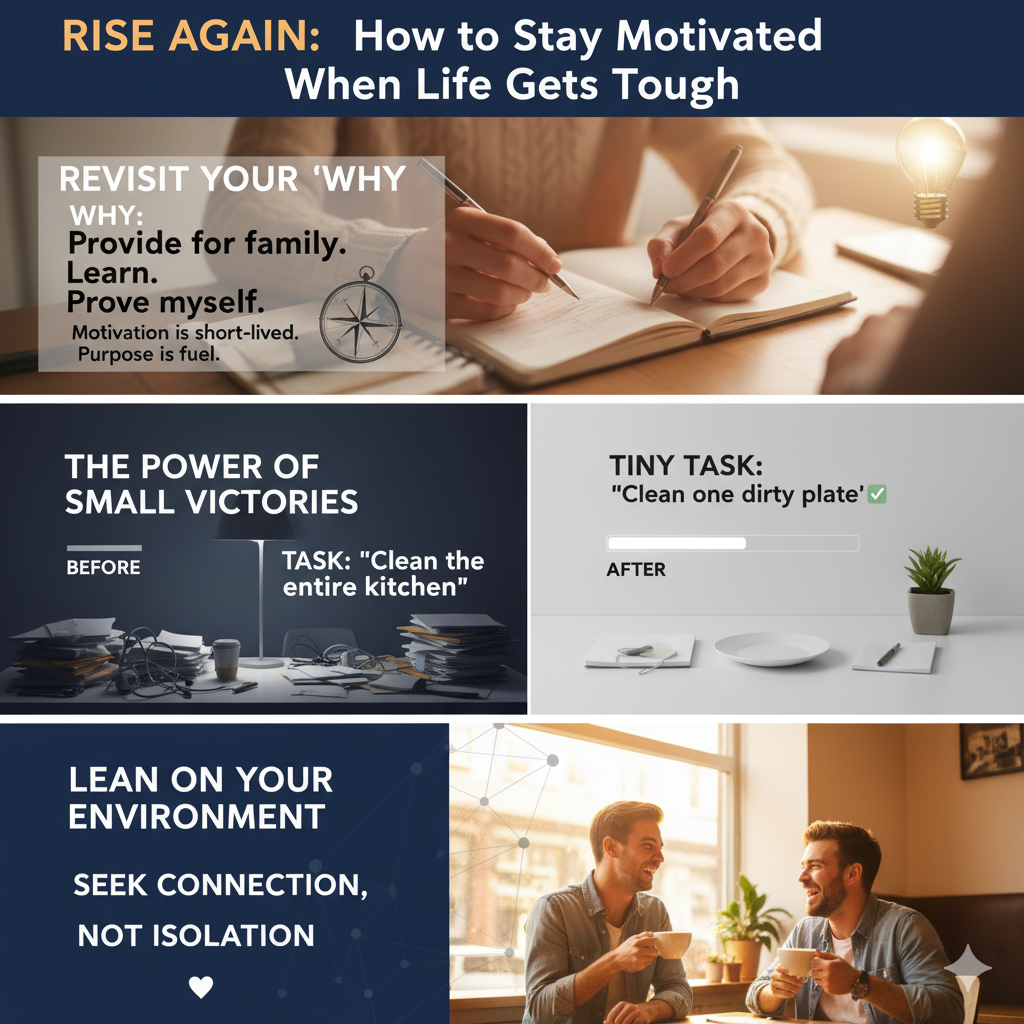
Rise Again: How to Maintain Your Motivation in the Face of Adversity
Life is full of unexpected turns. Everybody experiences challenging times, whether it’s an unforeseen professional failure, a personal tragedy, a project that stalls, or simply a general feeling of tiredness that makes getting out of bed seem like an impossible undertaking. Motivation is frequently the first thing to wane when times get difficult. It’s simple to get discouraged and wonder, “Why bother?” Having a toolkit on hand to support you, keep you going, and eventually help you get back up is more important than waiting for inspiration to come back to you.
Revisit Your “Why”
Reconnecting with your fundamental purpose should be your first priority when you feel trapped. Motivation is short-lived, but dedication to a more profound “why” endures.
Remember the basics: What motivated you to go on this adventure in the first place? Did you do it to support your family, learn a new skill, or prove yourself? Jot down that explanation. Make it noticeable. Use that first spark as your compass when the day-to-day grind obscures your vision. It reminds you that while the present suffering is momentary, the end result is permanent.
The Influence of Minor Victories
Your brain requires evidence that success is still possible when a major objective seems unachievable. The magic of “little steps” enters the picture here.
The 10-Minute Rule states that you should dedicate just ten minutes to working on the most difficult activity when you are completely unmotivated. You only need to begin; you don’t need to complete it. That little push of inertia is frequently sufficient to overcome the first obstacle. It’s okay if you give up after ten minutes; you still won a little.
Make time for a “Tiny Task”: Divide your ambitious objective into its most absurdly little parts. Make the assignment “Open the document and write one phrase” rather than “Write the chapter.” Make it “Clean one filthy plate” rather than “Clean the entire kitchen.” This technique shows your brain that you are still capable of making progress by making movement easier than standing still.
Depend on Your surroundings
Your social and physical surroundings should support you rather than hinder you.
Organize Your Physical Space: A disorganized environment is a continual source of negativity. Take twenty minutes to clean your workspace. Not only does a tidy desk or bed look good, but it also conveys a strong psychological signal that you are in charge.
Seek Connection Rather Than Isolation: When times are hard, it might be easy to retreat. However, a key component of resilience is interpersonal relationships. Speak with one encouraging individual.
You don’t even need to discuss your struggles; sometimes a brief conversation or a coffee break will change your mood and serve as a reminder that you’re not alone.
Maintaining motivation during difficult times requires a series of little, deliberate actions committed daily rather than a single epic run. You can create a commitment that is considerably more resilient than any fleeting sense of drive by firmly establishing your “why” and often acknowledging your little victories.